
 205-419-1605


Birmingham has a way of surprising people. Newcomers often picture a sleepy Southern town and instead find real hills, a food scene that punches well above its weight, a hospital system that anchors the entire regional economy, and a skyline watched over by a 56-foot iron man. If a move to the Magic City is on your horizon, here’s what actually matters once you get here, past the highlight reel.
A City Built Fast, and It Shows
Birmingham was founded in 1871 at one of the only spots in the world where iron ore, coal, and limestone all sit within a few miles of each other. The city grew so quickly on the strength of that combination that it earned the nickname “the Magic City,” and by the early 1900s it was producing more iron than any other city in the South. The Vulcan statue on top of Red Mountain, the largest cast-iron statue in the world, was built in 1904 to show off that industry at the St. Louis World’s Fair, and it still keeps watch over downtown today.
The steel and iron jobs that built the city are mostly gone now. What replaced them is a more diversified economy built around medicine, banking, and research, which matters more than you might expect once you start deciding where to live and what kind of commute you’re signing up for.
What It Actually Costs to Live Here
Compared to most major metros, Birmingham is a genuinely affordable place to plant roots. Cost-of-living indexes generally put the city several percentage points below the national average overall, and housing does most of the heavy lifting, home prices and rent here both run cheaper than the U.S. average by a wide enough margin to notice.
That affordability isn’t spread evenly, though. Inside the Birmingham city limits, median home prices generally fall somewhere in the $190,000s to $220,000 range, and rent for a typical apartment runs somewhere around $1,300–$1,400 a month. Cross over to the well-known communities on the other side of Red Mountain, Mountain Brook, Vestavia Hills, Homewood, and prices climb substantially, with medians ranging from the $350,000s to well over $1 million in some pockets. Where you land on that spectrum will shape a lot of your day-to-day life here, from your commute to your kids’ school zone.
Picking the Right Part of Town
This is the question every newcomer asks, and the honest answer is that it depends on what you’re optimizing for.
Inside the city, close to downtown and UAB: Forest Park and Crestwood are historic, walkable neighborhoods full of 1920s bungalows with quick access to the restaurants along Clairmont and Highland Avenues. Avondale has become Birmingham’s brewery and craft-food corridor, built around Avondale Park. Norwood, just north of downtown, is in the middle of a genuine comeback, with new development drawing interest from buyers looking for value. If true urban living is the goal, downtown’s loft and condo market has grown considerably in recent years.
“Over the Mountain,” for schools and space: Locals use this phrase for the communities on the far side of Red Mountain from downtown; Mountain Brook, Homewood, Vestavia Hills, and Hoover. Each has its own identity, its own school system, and its own price point, but all four consistently rank among the best places to live in Alabama. Hoover is the largest of the group and sits near the Riverchase Galleria and the Birmingham Zoo. Homewood is dense and walkable, with a lot of restaurants and shops within a short walk of each other. Mountain Brook is organized around a handful of small village centers, Mountain Brook Village, Crestline, English Village, that each function almost like their own little downtown.
Farther out: Trussville, Alabaster, and Pelham offer newer construction and more square footage per dollar, in exchange for a longer commute into the city.
One more thing worth knowing before you house-hunt: the city of Birmingham itself has actually been losing population in recent years, even as the broader ten-county metro area keeps growing. Nearly all of that metro growth is happening on the outer edges; Shelby, Tuscaloosa, St. Clair, and Cullman counties, which tells you something about where new development, new schools, and new retail are headed next.
The Weather Will Catch You Off Guard
Birmingham sits in the foothills of the Appalachians, so the terrain is hillier and more wooded than a lot of people picture when they think “Alabama.” That geography shapes the weather in a few specific ways.
Summers are long, hot, and humid, with highs typically in the low 90s from June through August and humidity that makes it feel like more. Winters, by contrast, are mild, daytime highs usually sit in the 50s, with only occasional nights below freezing. Snow is rare and usually light when it happens.
Here’s the part that catches newcomers off guard: even an inch or two of snow or ice can effectively shut the city down. It isn’t really about the amount of snow, it’s the hills, the fact that untreated roads stay slick longer here than they would somewhere flatter, and the fact that a lot of local drivers simply don’t get much practice driving on ice in a given year. If a winter storm is forecast, plan on staying off the roads for a day. That’s not a sign the city is unprepared; it’s just the smarter move given the terrain.
Spring and fall also bring Birmingham into what meteorologists call “Dixie Alley” — the severe-weather-prone stretch of the Southeast that covers most of Alabama. The state sees roughly 40 to 50 tornadoes in an average year, with the most active stretch running March through May and a smaller secondary peak in late fall. Unlike the tornadoes associated with the Great Plains, these storms can move fast and strike at night, which is why a lot of Birmingham-area homes have a designated safe room and why a weather radio or phone alerts are treated as a genuine household basic rather than an overreaction.
The Job Market Behind the Move
If you’re relocating for work, there’s a good chance it connects to one of Birmingham’s core industries: healthcare, banking, or manufacturing.
The University of Alabama at Birmingham (UAB) is the single largest employer in the state, with an academic medical center, a large hospital system, and a research footprint that ripples through the entire local economy. On the finance side, Regions Financial and ServisFirst Bank are both headquartered downtown, and the city is home to Vulcan Materials, the country’s largest producer of construction aggregates, along with Encompass Health and Medical Properties Trust. Add in a Honda manufacturing presence, a growing logistics sector tied to the interstate system converging here, and recent moves like Fannie Mae relocating jobs into the metro, and you get an economy that’s a lot more varied than Birmingham’s old steel-town reputation suggests.
Getting Around
Plan on driving. Birmingham’s public bus system, MAX Transit, covers a good part of the metro, but it doesn’t run on Sundays and hours are limited the rest of the week, so it works better as a supplement than a primary way to get around for most households.
Three interstates converge here: I-65 runs north-south, and I-20 and I-59 run together east-west, crossing paths just northwest of downtown at an interchange locals call “Malfunction Junction”, a nickname that’s stuck around even after a major rebuild replaced the old elevated roadway with a wider, modern viaduct a few years back. If you settle in one of the outer communities, I-459 loops around the southern and eastern side of the metro and will probably become part of your regular route.
Give yourself some extra time in those first few weeks to learn the local shortcuts. Between the hills, the interstate merges, and rush-hour backups around the Over-the-Mountain corridor, your commute will take some trial and error to dial in.
A Food Scene That Outperforms Expectations
Birmingham takes food seriously, and the accolades back it up. The city has produced multiple James Beard Award winners and nominees over the years, and in late 2025, eleven Birmingham restaurants were recognized in the Michelin Guide’s coverage of the American South. The Pepper Place area has grown into one of the city’s best dining and entertainment districts, and Avondale’s breweries pair well with a newer wave of restaurants leaning into modern Southern and Gulf Coast cooking. Whatever your food budget looks like, you won’t run out of new places to try for a long while.
Getting Outside
Birmingham’s green space is more extensive than its reputation suggests. Red Mountain Park, built on reclaimed mining land just outside downtown, spans 1,500 acres with miles of trails, ziplines, and a dog park. Ruffner Mountain Nature Preserve offers over a thousand acres and more than ten miles of hiking trails, and it’s free to enter. Downtown, Railroad Park connects to Sloss Furnaces, a former ironworks turned National Historic Landmark, by way of the Rotary Trail, a short walking and biking path built out of an old rail corridor. For a bigger day trip, Oak Mountain State Park and the Cahaba River both offer hiking, paddling, and camping within about half an hour of the city.
Schools and Higher Education
If you have kids, your neighborhood choice and your school district choice are basically the same decision in the Birmingham area. The Over-the-Mountain districts, Homewood, Vestavia Hills, Mountain Brook, and Hoover, consistently rank among the best in Alabama, though the exact order shifts from year to year depending on which ranking you look at. Trussville and Alabaster also show up regularly near the top. Birmingham City Schools serves the city itself.
For higher education, UAB is the dominant name, with Samford University and Miles College rounding out the local options, along with Jefferson State Community College for two-year and transfer programs.
A Few More Things Locals Take for Granted
- Sweet tea is the default. If you want it unsweetened, say so when you order.
- College football is a genuine cultural force here, even though Birmingham isn’t home to Alabama’s or Auburn’s campus. This is SEC country, and Saturdays in the fall reflect that.
- Pollen season is intense. Expect a yellow-green film on every car and windshield for a few weeks each spring.
- Everything is closer than it looks on a map once you account for the hills. A five-mile drive can take longer here than it would somewhere flatter.
Quick Answers for Anyone Still Deciding
Do I need a car in Birmingham? For almost everyone, yes. MAX Transit covers a good part of the metro, but with no Sunday service and limited hours, it works best as a backup rather than a primary way to get around.
Is Birmingham, Alabama affordable? Generally, yes, especially on housing. Cost-of-living indexes typically put Birmingham a few percentage points below the national average, with the biggest savings showing up in home prices and rent relative to metros of a similar size.
What’s the best area to live in near Birmingham? It depends on your priorities. Homewood, Mountain Brook, Vestavia Hills, and Hoover consistently rank among Alabama’s best for schools, while Forest Park, Crestwood, and Avondale offer walkable, historic character inside the city itself.
Does it snow in Birmingham? Rarely, and not much when it does. Because of the hilly terrain and limited snow-clearing equipment, even an inch of snow or ice can shut roads down for a day or two.
Is Birmingham in Tornado Alley? Not the traditional one. Birmingham sits in “Dixie Alley,” a separate severe-weather region covering much of the Southeast, with peak tornado activity in spring and a smaller peak in late fall.
Making the Actual Move
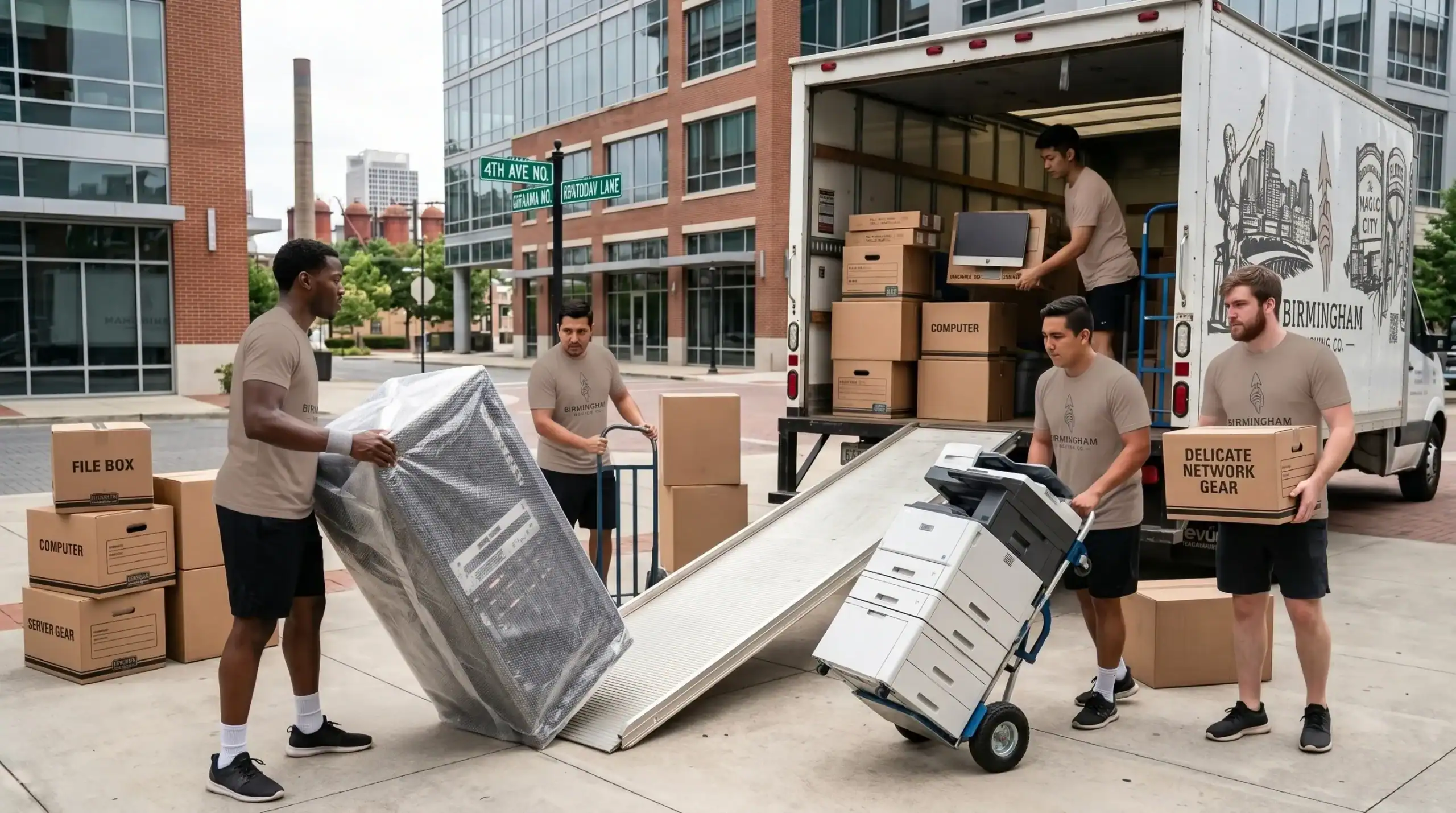
Knowing your new city helps you plan, but at some point the boxes still have to get from one place to another. Whether that’s a downtown loft, a bungalow in Forest Park, or a new build out past Hoover, Birmingham Moving Company works across every corner of the metro and knows the difference between an Over-the-Mountain move and a downtown high-rise move before the truck ever shows up. If a move to or around Birmingham is on your calendar, reach out and we’ll help you sort out the details.
